
Mechanical Repair
Sunroof Track and Motor Repair in Houston
Rails, guides, sliders and carriers, drive cables, motors and mechanism assemblies — repaired, aligned and tested.
This page is about the hardware itself: the parts that carry a sunroof panel through its travel, what goes wrong with them, and what repairing them actually involves.
A sunroof mechanism is a linked assembly. The motor drives cables, the cables drive carriers, the carriers run in guides set into rails, and the whole thing is timed so both sides move together. Repairing it well means knowing which link in that chain failed — and which parts merely show the consequences.
Sunroof King has been rebuilding and repairing sunroof mechanisms in Houston since 1979.

What A Sunroof Mechanism Is Made Of
Designs vary a great deal between manufacturers, and between a small factory sunroof and a large panoramic system. Depending on the vehicle, the parts that move a roof panel can include:
Not every vehicle uses every one of these. Plenty of systems have no cable drive at all, and the mechanism layout on a panoramic roof can look very little like the one in a compact car. Listing the possibilities shows the range we work across — it is not a description of your particular roof.
Sunroof Track Repair
Rails, Guides, Sliders And Carriers
Tracks take the load every time the roof moves, and they are where most mechanical sunroof faults are eventually traced to.
Wear. Guides and carriers are working parts. Over enough cycles the bearing surfaces wear, the fit inside the rail loosens, and the panel starts sitting or travelling slightly differently from how it should.
Breakage. Carriers, sliders and the plastic and metal parts that connect them to the lift linkage can crack or snap outright. A broken carrier on one side is one of the most common reasons a panel goes out of square.
Binding. Debris, a displaced component, hardened old lubricant or a part that has moved out of position can obstruct the rail. The mechanism then has to force the panel through, which loads everything upstream of the obstruction.
Misalignment. A rail that has been knocked, a cassette that has shifted, or an assembly that was reinstalled without being set correctly will run the panel out of true even when every individual part is sound.
Which of those is present changes the repair completely, and they are not distinguishable from outside the vehicle. That is why the assembly gets inspected rather than assessed from a description.
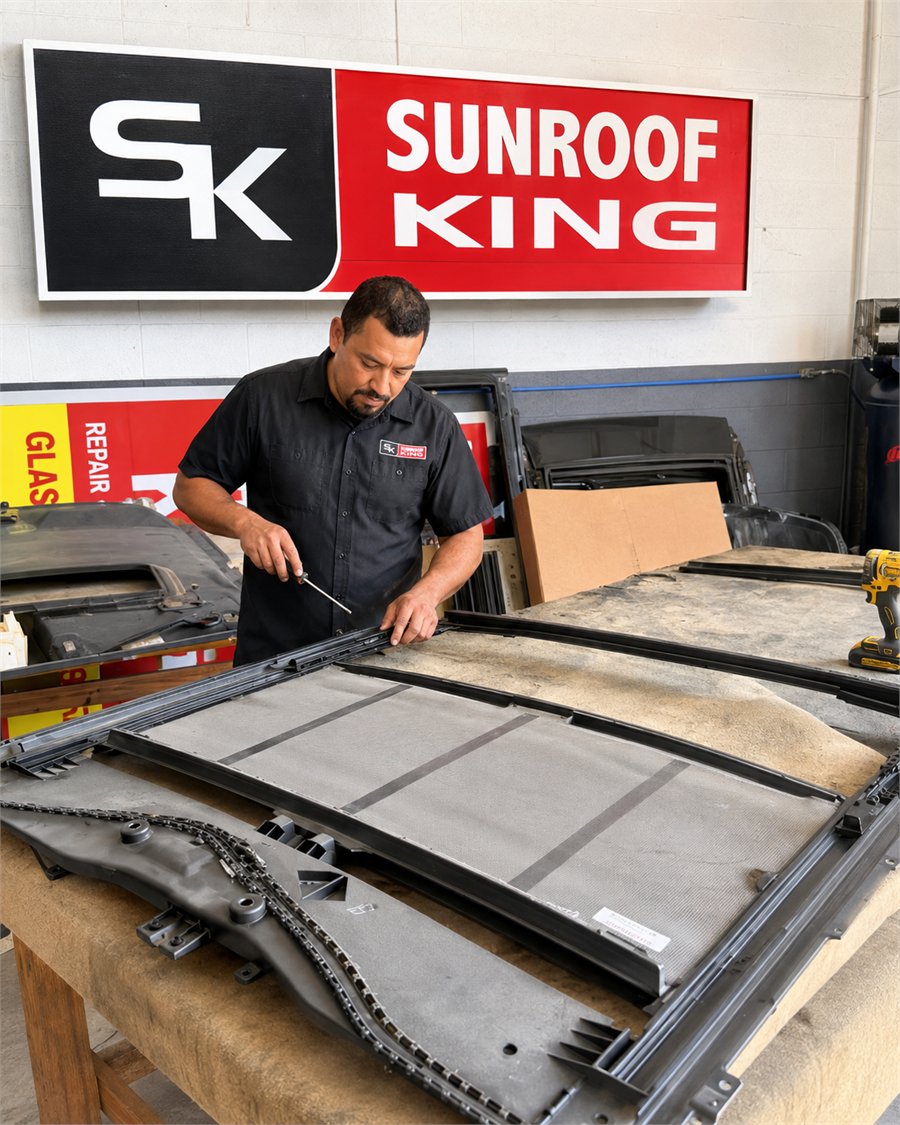
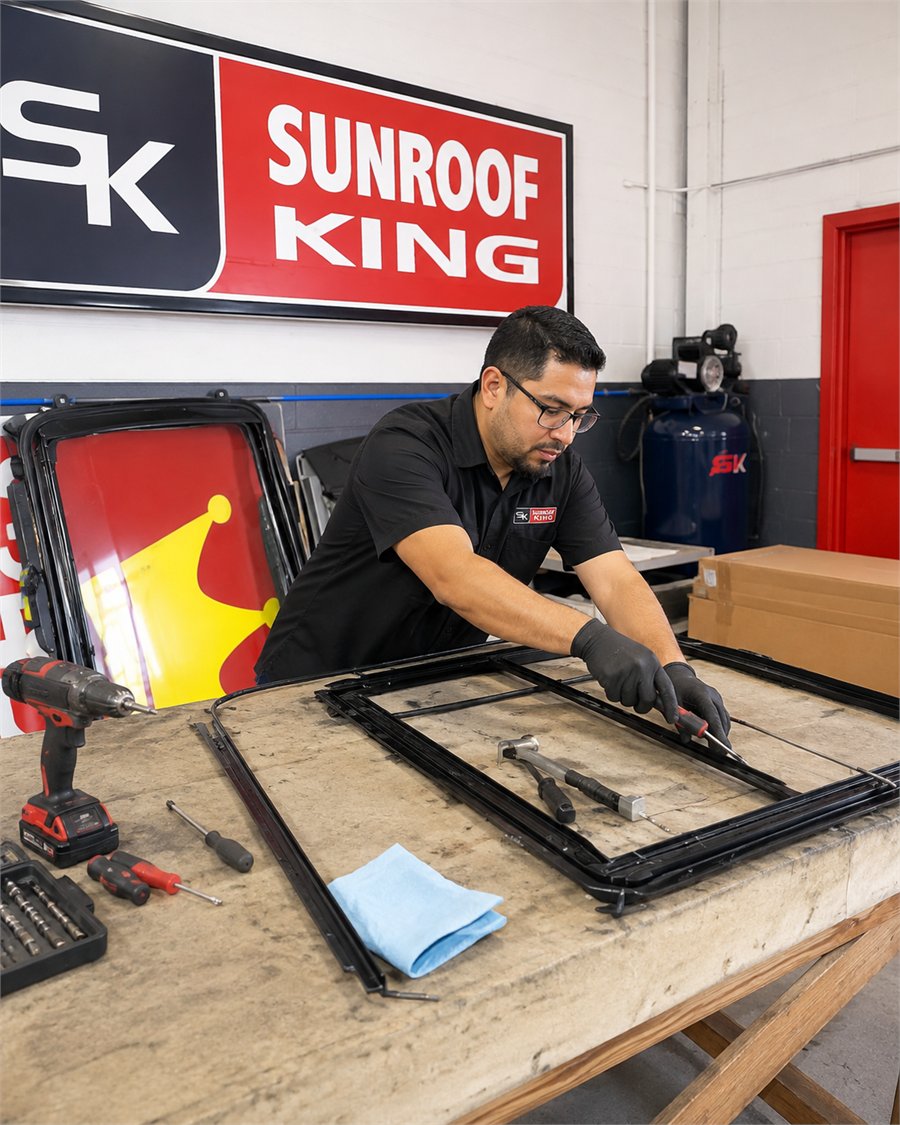
Mechanism assemblies out of the vehicle and on our bench, where the rails and carriers can actually be worked on.
Sunroof Motor Repair And Diagnosis
Motors do fail. They wear out, they can develop electrical faults, and the drive gear that engages the cables can strip. When a motor is genuinely the failed part, replacing it is the correct repair.
But a roof that does not move is not automatically a bad motor, and this is the single most expensive assumption in sunroof work.
A jammed or damaged mechanism can stop a roof just as effectively as a dead motor. If a carrier has broken, a cable has come out of its channel, or something is binding hard in a rail, the panel will not move — and on many vehicles the system will stop trying rather than force it. The motor in that scenario is often in perfectly serviceable condition.
The practical consequence is worth stating plainly: fitting a new motor to a damaged mechanism does not fix the roof. The new motor faces exactly the same obstruction the old one did, and the money spent has bought nothing. Establishing whether the fault is mechanical, electrical, or both, is what the inspection is for — and it comes before any part is ordered.

Working at the roof opening with the interior protected, checking how the mechanism responds.
Cable And Drive Mechanism Problems
On systems that use them, drive cables are what turns the motor's rotation into movement along each rail. They are not brake-style cables under tension — they are usually rigid enough to push as well as pull, which is how they drive the panel in both directions.
When a cable is the problem it can be damaged along its length, stripped where it engages the drive gear, displaced out of its channel, or broken outright. Because one cable normally drives one side, a cable fault very often presents as one side of the panel no longer keeping pace with the other.
Not every vehicle is built this way. Some designs use different drive arrangements, and some mechanisms use regulator-style assemblies rather than a cable running in a channel. What is true across designs is that the drive components sit in the middle of the chain: they receive load from the motor and deliver it to the carriers, so they suffer when either end of that chain is in trouble.
That also means a broken cable is frequently a symptom rather than the root cause. A cable that has stripped because a carrier seized is a different repair from a cable that simply wore out, and replacing only the cable in the first case leaves the actual fault in the roof.
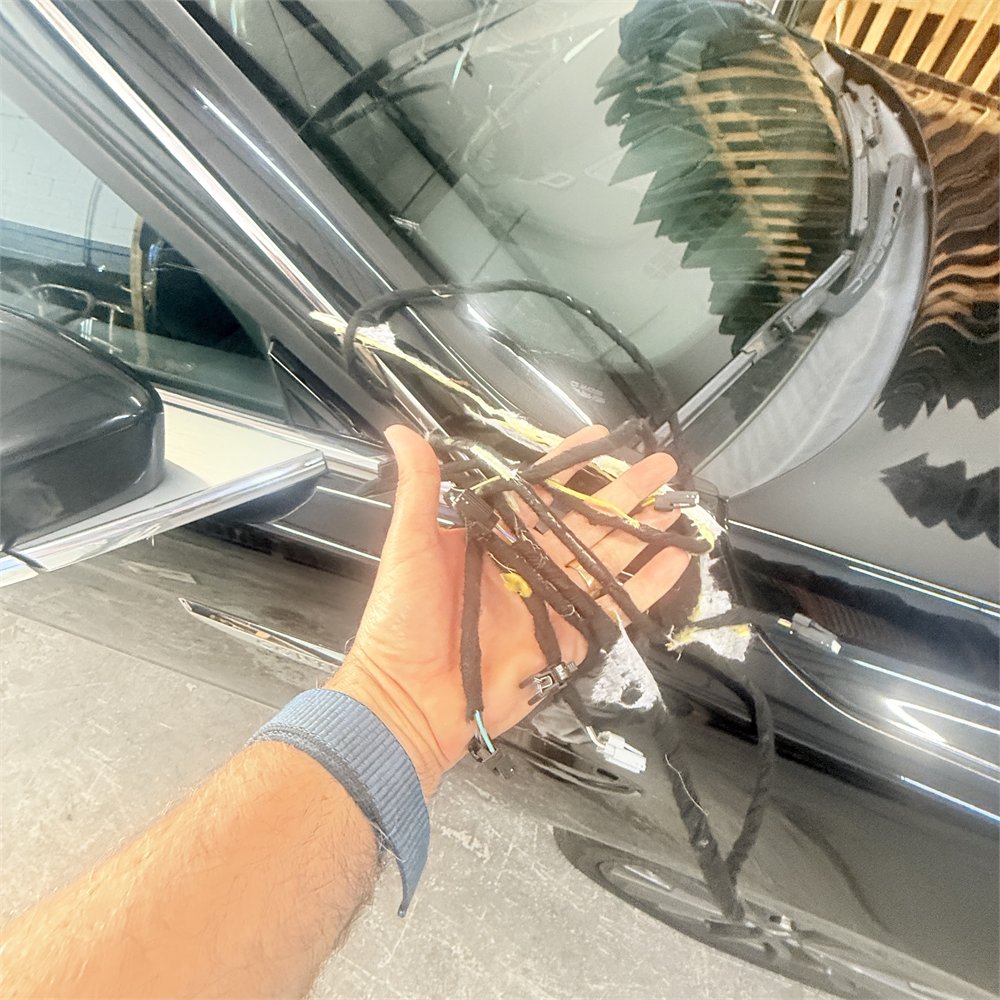
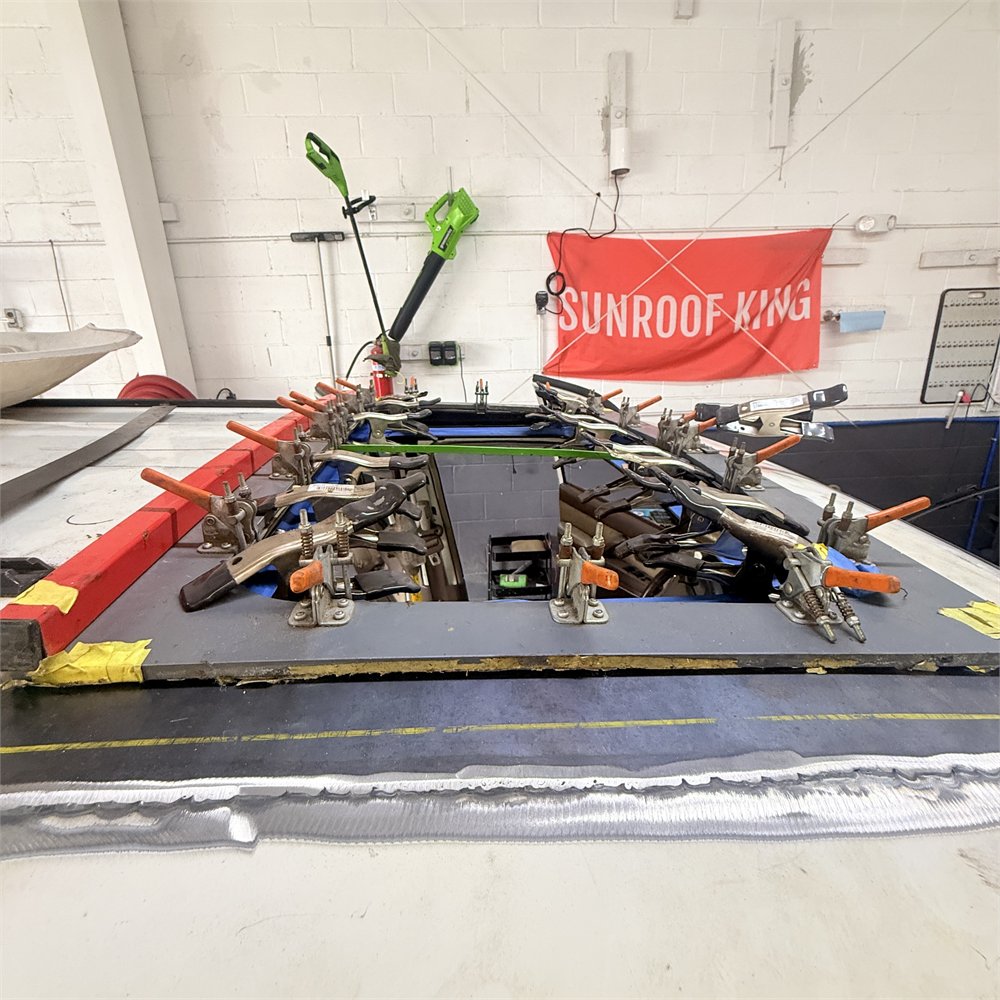
Drive cables out of a roof, and a sunroof assembly clamped during work at our Houston shop.
One Side Moving Differently From The Other
Both sides of a sunroof panel are driven together and are meant to arrive together. When they stop doing so, the cause is mechanical on one side or in what synchronises the two.
Looked at as components rather than as a symptom, the candidates are reasonably short: a carrier or slider that has worn or broken on the lagging side; a guide or rail that is damaged, obstructed or out of position; a drive cable that is damaged, displaced or stripped; a lift arm or linkage that has failed; or a mechanism that has lost its synchronisation so the two sides are no longer timed to each other.
Synchronisation is worth understanding, because it is the one that is not a broken part. On many systems the two sides are set to a fixed relationship during assembly. If that relationship is disturbed — by a failure, or by a previous repair carried out without resetting it — the panel runs out of square even though the components themselves may be sound. Restoring it is a setup operation, not a parts replacement.
Either way, a panel running out of square is loading its guides sideways rather than travelling along them, which is why the fault tends to get worse rather than stay level.
Clicking, Grinding Or Straining Noises
Noise from a sunroof mechanism is mechanical information. Something in the assembly is under a load it was not designed for, or two parts are meeting that should not be.
From a component point of view, the usual sources are a drive gear or cable skipping its engagement, a carrier dragging in a rail rather than running in it, debris or a broken fragment caught in the path, a linkage that has failed and is moving where it should be located, or a motor working against resistance further down the chain.
Which is why the noise identifies a problem, not a part. The motor is usually the loudest thing in the assembly and the easiest to hear, so it collects the blame for noises that originate elsewhere. Diagnosing what is actually being loaded — before anything is replaced — is the difference between fixing the roof and replacing a component that was doing its job.
What is worth acting on immediately is the operating: a mechanism that is grinding is a mechanism that is damaging itself, and each further cycle adds to the repair.
Track Alignment And Reassembly
The Part Of The Job That Decides Whether It Lasts
Replacing a failed component is not the end of a mechanical sunroof repair. How the assembly goes back together determines whether the roof travels properly afterwards — and whether the new part lasts.
Alignment. The panel has to sit square in its opening and flush with the roof line, at the correct height front and rear. A panel set even slightly out will catch its seal, sit proud, or load one side of the mechanism harder than the other.
Synchronisation. Where the design requires the two sides to be set to each other, that relationship is established during reassembly. Skip it and the roof runs out of square from the first cycle.
Full-travel testing. A roof that moves is not the same as a roof that works. It gets run through its complete range — tilt and slide, both directions, all the way to each limit — because faults show up at the ends of travel and at the transitions, not in the middle.
This stage is also where a repair that was done properly separates itself from one that was rushed. A mechanism reassembled without setting alignment will often work well enough to hand back and fail again later, which is the outcome the alignment step exists to prevent.
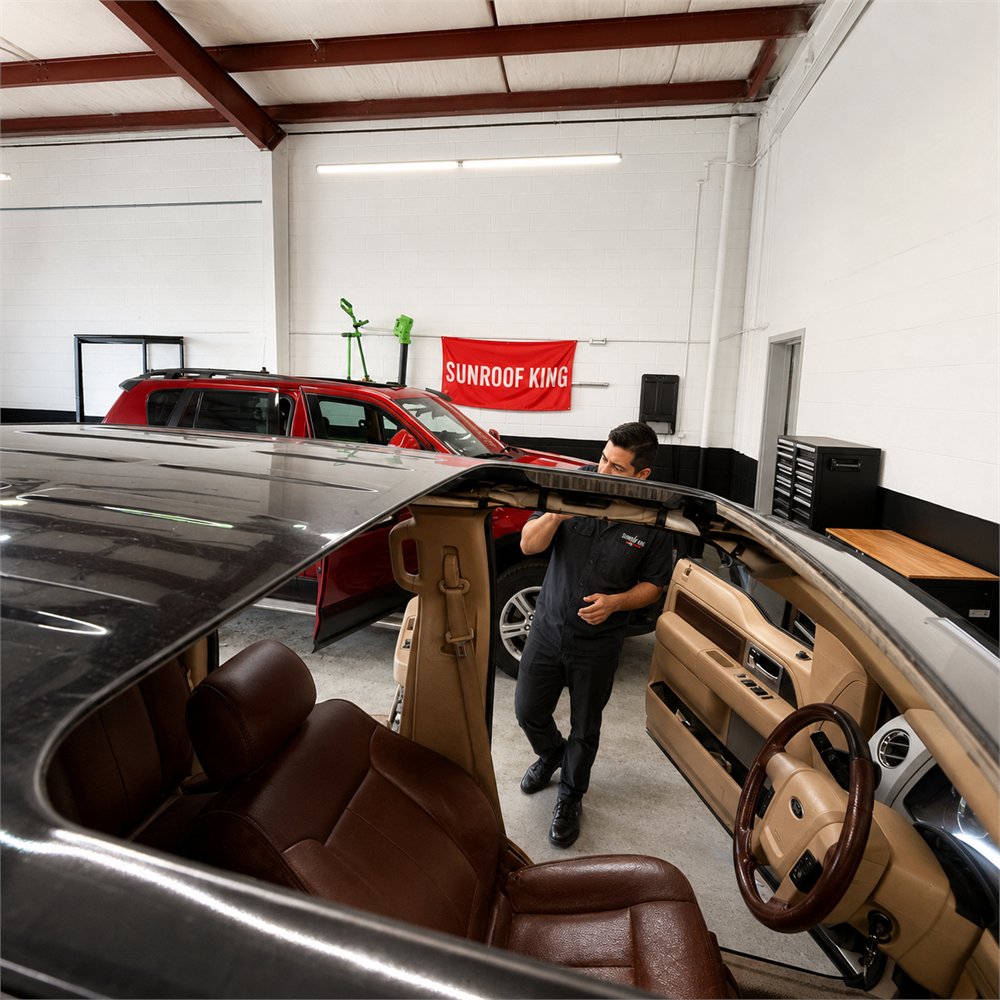
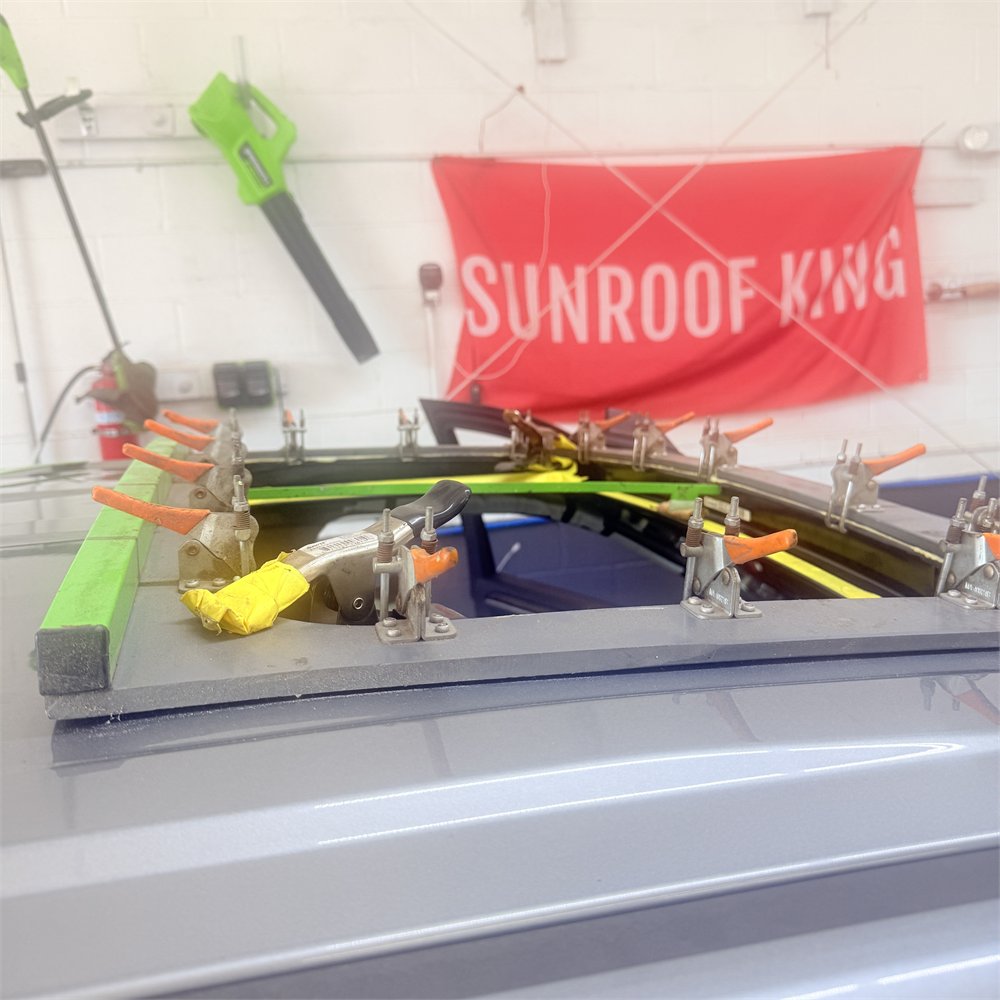
Moving a glass panel in the bay, and an assembly clamped and set at the vehicle — both at 9330 Westpark Dr.
Interior Access For Mechanical Repairs
The mechanism sits in the cassette between the outer roof panel and the headliner, so how much of the interior has to come apart depends entirely on which part failed and where it sits.
Some work can be done through the roof opening with the glass removed. Some requires trim around the roof to come out. Some requires the headliner to be lowered or removed to reach the cassette, and on certain repairs the assembly comes out of the vehicle altogether so it can be worked on properly at the bench — which is what several of the photographs on this page show.
Not every track or motor repair requires full headliner or cassette removal. That is worth saying clearly, because it is a common assumption and it is often wrong. Establishing how far in the job needs to go is part of the inspection, and we tell you what is involved before that work starts rather than afterwards.
Where the headliner does have to come down, it is also the sensible moment to deal with one that is already sagging or marked, since the labour of removing it is happening anyway — see our Auto Headliner Repair page.

Headliner out and the mechanism reachable from inside the vehicle.
How We Approach Diagnosis
Not Every Vehicle Requires Every Step
The sequence below is how we generally work through a mechanical sunroof fault. It is an order of work rather than a checklist every vehicle runs end to end — on some roofs the cause is obvious within the first two steps.
Inspect Roof Position And Alignment
Where the panel is sitting, whether it is square in its opening, and whether it is level front to back and side to side. A panel already out of true is pointing at which side of the mechanism to look at first.
Test Operation Where It Is Safe To Do So
If the roof can be moved without risking further damage, how it travels is genuinely useful information. If operating it looks likely to make the damage worse, we leave it where it is.
Listen For The Motor And Mechanism Response
Whether the motor runs at all, whether it runs and the panel does not follow, and what the assembly sounds like while it happens. Each of those points the inspection in a different direction.
Inspect The Accessible Tracks And Guides
The parts of the rails, guides, carriers and visible drive components that can be reached without stripping the interior are checked for wear, breakage, debris and obstruction.
Determine Whether The Fault Is Mechanical, Electrical Or Both
This is the decision the rest of the repair depends on. Power to the roof, the switch and the motor are checked where that is relevant, alongside what the mechanical inspection has shown, so a motor is never replaced to solve a jammed track.
Access The Assembly As Required
Trim, headliner or the cassette itself, depending on where the fault sits. The interior is covered first and components come out in order, so nothing is damaged on the way to the mechanism.
Repair Or Replace The Failed Component
What actually failed is dealt with — and so is anything that failed because of it, so the same fault is not left in the roof to repeat itself.
Align, Reassemble And Test
The mechanism is set so the panel runs square and sits correctly, the interior goes back together, and the roof is run through its full travel in both directions before the vehicle is handed back.
What A Noise — Or Silence — Actually Tells You
Hearing The Motor Does Not Mean The Motor Is Bad
If you press the switch and hear the motor running, that motor is receiving power and turning. In other words the electrical side is doing its job, and what you are hearing is effort that is not reaching the glass.
A stripped drive gear, a damaged cable, a broken carrier or something binding in a rail will all produce exactly that. The motor is frequently the healthiest part of the assembly at the moment it is being blamed.
A Silent Roof Does Not Prove A Failed Motor Either
Silence points the inspection toward the electrical and control side first — power, the switch, wiring, the fuse, the module, the motor. That is a sensible place to begin.
But it is not proof. A mechanism jammed hard enough will cause some systems to stop attempting the movement at all, and some vehicles will not run the roof when other conditions are not met. Silence narrows the search; it does not conclude it.
Replacing A Motor Without Diagnosing The Mechanism Can Fix Nothing
This follows from the two points above, and it is the reason this page keeps returning to diagnosis. If a track, carrier or cable is the actual fault, a new motor is fitted into the same obstruction and the roof behaves exactly as it did before — only now a part has been paid for.
It can also work in the other direction: a motor that failed because it had been straining against a damaged mechanism for months will fail again if only the motor is renewed.
Please Do Not Keep Forcing A Binding Roof
If the panel is crooked, grinding, binding or repeatedly stopping, stop operating it and do not force it by hand. The assembly is already working against a fault, and each further cycle puts load through whatever is already the weak point — which is how a slipped cable becomes a stripped one and a worn carrier becomes a broken one.
We are also not going to talk you through forcing tracks, pulling drive cables, bypassing the motor, removing the headliner, dismantling the cassette or manually synchronising a broken mechanism. Those sit behind trim that has to come out in order, and attempting them on an assembly that is already faulty tends to add damage rather than resolve it. Call or text (832) 217-0430 and bring the vehicle in instead.