
Leak Diagnosis & Repair
Sunroof Leak Repair in Houston
Damp headliners, wet pillars, water in the footwell, and the drainage system behind most of it.
A sunroof is not sealed against water the way a windshield is. On most factory systems water is expected to get past the glass — it is caught in channels around the opening and routed away through hoses that run down inside the vehicle’s pillars.
So a sunroof leak is usually a drainage problem rather than a sealing problem. But which part of that system has failed, and whether the water is even coming from the roof at all, is a question worth answering properly before anything is taken apart.
Sunroof King has been tracing water leaks on sunroof-equipped vehicles in Houston since 1979.

Sunroof Leak Diagnosis
Where The Water Appears Is Not Where It Came In
Water inside a vehicle tells you that water is getting in somewhere. It does not tell you where, and that distinction is the whole reason leak work starts with diagnosis rather than with parts.
Water runs downhill and follows whatever surface it lands on. By the time it becomes visible — a damp patch on the headliner, a wet pillar trim, a soaked carpet on one side — it may have travelled a considerable distance from the point it entered. A wet footwell is a symptom of water arriving there, not evidence that the leak is above it.
It is also worth saying plainly that not every water complaint on a sunroof-equipped vehicle is a sunroof leak. Windshield and rear glass seals, door seals, body seams and other openings can all put water inside a car. Establishing the actual path is what stops the wrong thing being repaired.
How Sunroof Drainage Works
This surprises a lot of people: a small amount of water getting past the glass is normal and expected. The sunroof is designed for it.
Around the roof opening there is a channel — effectively a shallow gutter built into the cassette that holds the whole assembly. Water that gets past the glass or its seal lands in that channel instead of in the cabin. From there it is guided to collection points, usually at the corners, where drain hoses are attached. Those hoses run down inside the vehicle’s pillars and discharge underneath the car.
When that system works, water arrives and leaves and you never know about it. When any part of it stops working, the channel overflows or the water escapes on its way down — and it ends up inside the vehicle instead.
Designs vary considerably. The graphic at the top of this page shows one common arrangement, but the number of drains, where they sit, how the hoses are routed and how they connect differ between manufacturers and between a small factory sunroof and a large panoramic roof. Your vehicle may not be laid out the way that illustration shows.
Clogged Or Restricted Drain Hoses
This is the best known sunroof leak cause, and it is a real one. Leaves, pollen, dust, grit and general debris wash into the channel along with the water. Over time that material can build up at the drain openings or inside the hoses themselves and slow or stop the flow.
Houston makes this more likely than most places: heavy rain arrives quickly, and a channel that drains slowly can fill faster than it empties. Parking under trees adds material to the system all year round.
But being the best known cause is not the same as being the only one. A restricted drain is one possibility among several, and the fact that a leak exists is not evidence that a drain is blocked. That is why we check the drainage system rather than assuming it — and why we look at the rest of the water path too.
Disconnected, Damaged Or Deteriorated Hoses
A drain hose can be perfectly clear and still fail to do its job, and this is the group of causes people rarely think of.
Hoses connect to the cassette at one end and route down through the pillars to an exit at the other. Those connections can work loose or come off entirely. The hose itself can be split, crushed, kinked or pinched somewhere along its run. On older vehicles the material can harden or perish with age. Any of those puts water inside the pillar or the headliner rather than out under the car — often with no blockage anywhere in the system.
Previous work is worth mentioning too. A hose that was disturbed during unrelated repairs and not refitted correctly can leak from that day onward, and the connection between the two is easy to miss because the symptoms may not appear until the next heavy rain.
Drain Channels And Corner Drains
Before water reaches a hose it has to reach a drain, and that is the channel’s job. The channel catches what gets past the glass and carries it to the collection points where the hoses attach.
Problems here look different from a blocked hose. Debris can sit in the channel and dam the flow so water backs up and spills over an edge. A channel can be damaged, distorted or partially blocked by a component that has moved. Where a drain opening meets the channel, that junction can be obstructed or the fitting can be damaged.
How many drains a roof has and where they sit is not standard. Many systems collect at the corners; others do not. A panoramic roof spanning most of the vehicle handles far more water than a small sunroof and may be arranged quite differently. What matters is whether your vehicle’s arrangement is doing its job — which is something to look at, not assume.
Water Around The Headliner Or Pillars
Because the drain hoses run down inside the pillars, water escaping from that system tends to appear at the pillars or along the edge of the headliner — and often some distance from where it actually left the hose.
Common signs are a damp or stained headliner near a corner of the roof, water running down the inside of an A-pillar during rain, a wet seat belt or trim panel, a damp carpet on one side of the vehicle, or a persistent musty smell with no obvious wet patch at all.
The last one is worth taking seriously. Water can sit under carpet or inside trim for a long time without ever showing on the surface, and the smell may be the only sign. Prolonged damp is also how a headliner ends up stained or separating — if yours has already been affected, our Auto Headliner Repair page covers that side of the work.
None of these locations identifies the source on its own. They tell us where the water is arriving, which is the starting point for tracing it back.
Why A Leak Is Not Always A Blocked Drain
The Most Common Misunderstanding About Sunroof Leaks
“Just clear the drains” is the advice most people have heard, and sometimes clearing a restricted drain genuinely is the repair. But a leak complaint on a sunroof-equipped vehicle can come from any of the following:
Those are genuinely different repairs. Clearing a drain does nothing for a hose that has come off its connection, and a cleared drain on a vehicle whose water is arriving from a windshield seal will leak again at the next storm — leaving the owner convinced the repair failed when the actual fault was never touched.
Diagnosis comes first. We find where the water is actually getting in, then tell you what the repair involves.
Why Interior Access May Be Needed
Most of a sunroof drainage system is not visible. The channel sits in the cassette between the outer roof panel and the headliner, and the hoses run down inside the pillars behind the trim. To inspect a connection or a length of hose properly, that trim has to come off.
How far in a particular job goes depends entirely on what has failed and where. Some work can be done at the roof opening with little disassembly. Some needs pillar trim removed to reach a hose or a connection. Some needs the headliner lowered or removed to reach the cassette.
Not every leak repair requires full headliner or cassette removal — that is a common assumption and it is frequently wrong. Establishing how much access is genuinely needed is part of the diagnosis, and we tell you what is involved before that work begins rather than afterwards.
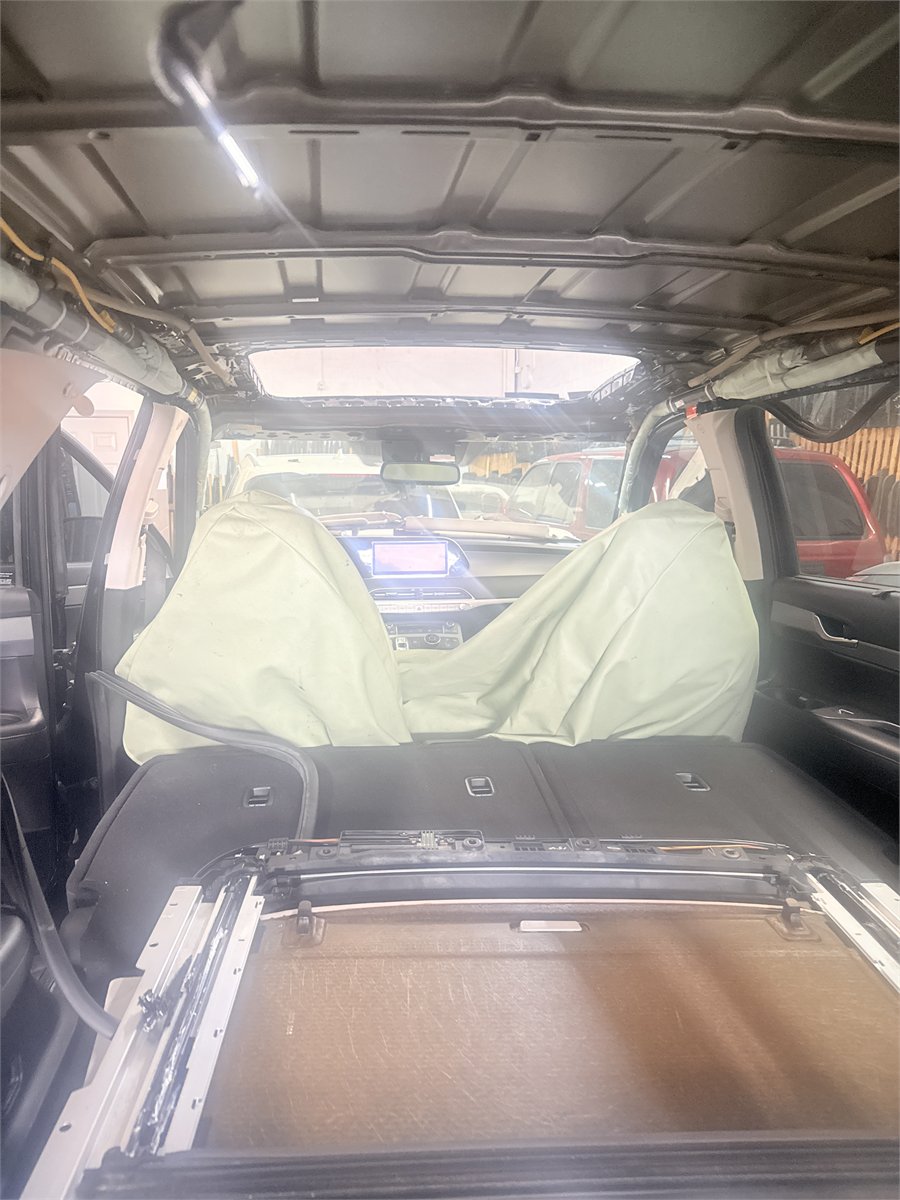

The headliner down with the roof structure exposed, and a technician working at the headliner — both at our Houston shop.
Interior Protection
Leak work involves water and it involves taking parts of the interior out, usually on a vehicle whose interior has already had water in it. Covering the seats, carpet and console before anything starts is simply part of doing the job properly.
Trim, pillar covers and fixings come out in order and are kept together so everything goes back the way it should. Where the headliner has to come down, it is handled so it is not creased or marked on the way out — a board that has already been damp is easier to damage than a dry one.

Seats covered and pillar trim removed before leak inspection begins at 9330 Westpark Dr.
How We Approach Leak Diagnosis
Not Every Vehicle Requires Every Step
Inspect Where Water Is Appearing
Where it shows, when it shows, and how much. Anything you have noticed about which conditions bring it on — heavy rain, a car wash, parking on a slope — is genuinely useful here.
Inspect The Roof Opening And Drainage Areas
The condition of the opening, the seal, the channel and the visible drain points — including any debris sitting where water is meant to flow.
Trace The Likely Water Path
Working back from where the water appears toward where it could have entered. This is the step that separates a sunroof drainage leak from water arriving via another route entirely.
Inspect Drains, Hoses And Connections Where Appropriate
Whether water reaches the drains, whether it gets through them, and whether the hoses and their connections are intact and still attached where they can be reached.
Determine The Interior Access Required
How much trim or headliner needs to come out to reach the actual fault. You are told what is involved before that work starts.
Repair The Actual Fault
What has genuinely failed is dealt with — clearing restricted drainage, reconnecting or replacing a hose, addressing a channel or connection problem, or whatever the diagnosis has identified.
Reassemble And Test
The interior goes back together and the drainage is tested so we can see water going where it should before the vehicle is handed back.
If Water Is Getting In
Try Not To Let It Keep Soaking
Park under cover where you can and dry out what you are able to reach, so the interior is not repeatedly saturated while the vehicle waits. Water that sits in carpet and underlay causes problems of its own — smell, staining, and damp reaching things that should stay dry.
If you have noticed a pattern — which side, how heavy the rain has to be, whether a car wash brings it on — tell us. It genuinely narrows the search.
What We Will Not Talk You Through Over The Phone
We are not going to give you instructions for removing a headliner, pulling pillar trim, dismantling the cassette, forcing compressed air through drains, or pushing tools or wire down drain hoses.
The last two matter most. A hose is easy to split, puncture or push off its connection from the inside, and doing so converts a restricted drain into a hose discharging water straight into the pillar — a worse leak than the one you started with, and one that now needs the trim out to fix.
Call or text (832) 217-0430 and bring the vehicle in. All of our work is carried out at our Houston shop, Monday to Friday, 8:00 AM to 5:00 PM.