
Sunroof Repair & Diagnosis
Sunroof Stuck Open or Closed Repair in Houston
A roof that will not close, will not open, stops halfway, reverses on its own or sits crooked.
A sunroof is not a single part. Glass, guides, tracks, cables, a drive mechanism, a motor and the switch and control side all have to work together, and a roof that has stopped moving properly can come from any point in that chain — or from more than one at once.
That is why the symptom on its own does not tell you what is broken. The same complaint can have very different causes on two different vehicles, so the sensible order is to find out what is actually happening before deciding what needs to be repaired or replaced.
Sunroof King has been working on sunroofs and panoramic roofs in Houston since 1979. Bring the vehicle to our shop and we will look at it.

Sunroof Stuck Open Or Partially Open
The Complaint We Hear Most Often
A roof that is sitting open, tilted up or parked somewhere in the middle of its travel is the version of this problem people notice fastest, because the vehicle cannot simply be left that way.
What is behind it varies. It can be the tracks and guides the glass runs in, the cables that drive each side, the lift and slide mechanism that raises and carries the panel, the motor, the alignment of the glass in its opening, or the electrical and control side — switch, wiring, or the module that tells the roof what to do. Wear, debris, a previous repair and physical damage all show up here too.
We are deliberately not going to tell you which one it is from the description alone. A roof stuck open on one vehicle and a roof stuck open on another can be two completely unrelated faults, and guessing at this stage is how the wrong part ends up being replaced. What the symptom does tell us is where to start looking.
If the roof is stuck open and the vehicle is exposed to Houston weather, please see the advice further down this page before you keep pressing the switch.
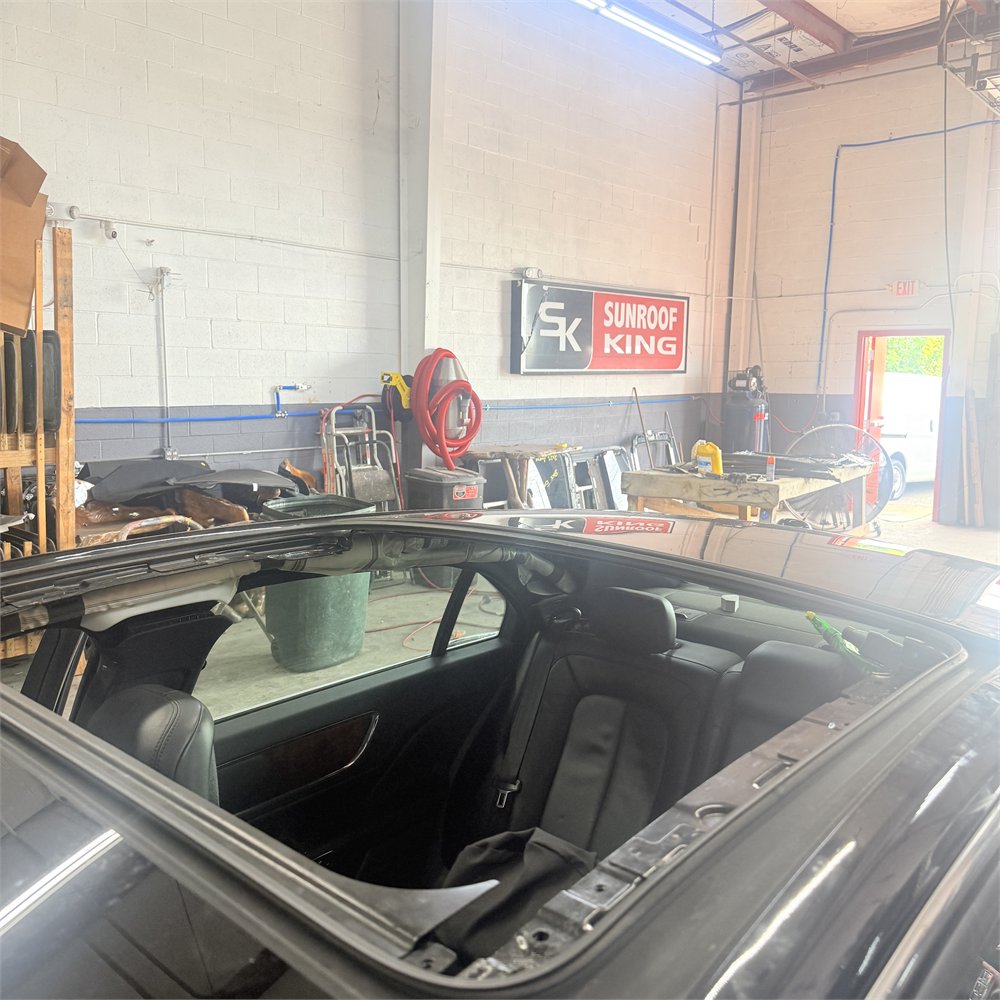
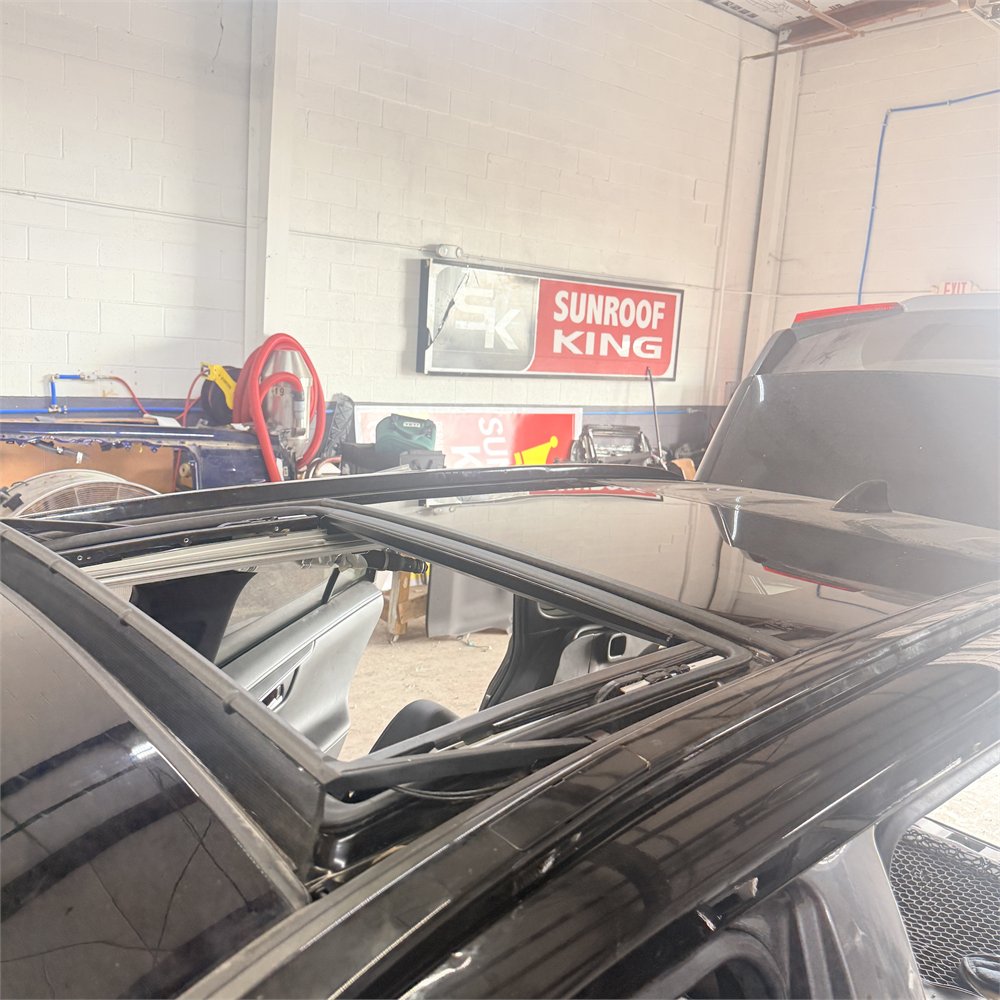
Two roofs that came in stuck open — both photographed in our Houston shop.
Sunroof Stuck Closed Or Will Not Open
A roof that stays shut is less urgent than one stuck open, and it is often left far longer as a result. It is worth understanding that it is not a different category of fault: the mechanical and electrical problems that leave a roof stuck open are largely the same ones that can leave it stuck closed.
The panel may not move at all, it may make a noise without moving, or it may lift slightly at the back and then stop. Tracks, guides, cables, the drive mechanism, the motor, the switch and the control side are all candidates, exactly as they are for a roof stuck open.
This is the point where diagnosis matters most. Because a closed roof is not causing any immediate inconvenience, it is tempting to skip straight to replacing whatever seems most likely — usually the motor. A part fitted on a guess is a part paid for on a guess. Finding out what is actually stopping the roof first is what keeps the repair honest.
Sunroof Stops Halfway Or Reverses On Its Own
A roof that travels part of the way and then stops, or that starts to close and immediately runs back open, is behaving differently from one that will not move at all — and that difference is genuinely useful information.
Many roofs are designed to back off when they meet more resistance than expected. So a roof that keeps reversing is often telling you that something in its path is harder to move than it should be. Abnormal resistance or binding can come from the tracks and guides, from the glass being out of alignment in its opening, from a cable or drive component that is not running freely, or from wear in the mechanism itself.
It can also be the control side rather than a mechanical obstruction, or a roof that has lost its stored positions and no longer knows where its own limits are.
What all of those have in common is that the roof is already working against something. Repeatedly running it back and forth to see if it will make it through is the one response worth avoiding, and the reason why is in the advice section below.
Clicking Or Grinding Noise When You Press The Switch
An Important Point Worth Understanding
If you press the switch and hear clicking, grinding, whirring or straining from above the headliner, it is very natural to conclude that the motor is failing. It is the part making the noise, after all.
Hearing the motor does not automatically mean the motor is bad. In many cases the noise is evidence of the opposite: the motor is receiving power and trying to turn, which means the electrical side is doing its job. What the sound is telling you is that the effort is not reaching the glass properly.
That can happen for reasons that have nothing to do with the motor. A cable can be damaged or out of its track. A guide or slider can be worn or broken. Debris or a failed component can be binding in the track. Something in the drive mechanism can have separated so the motor spins without carrying the panel. In each of those cases the noise you hear is the symptom, and the motor itself may be perfectly serviceable.
This matters commercially, not just technically. A motor replaced on the strength of a noise is a repair that can leave the actual fault untouched — and a new motor driving a damaged track or cable is doing the same job the old one was struggling with. The noise is a reason to inspect the roof, not a diagnosis on its own.
No Sound And No Movement At All
The opposite situation — you press the switch and nothing happens, with no noise from the roof at all — points the inspection in a different direction to begin with.
When nothing moves and nothing is heard, the electrical and control side is the reasonable place to start: power reaching the roof, the switch itself, wiring and connections, the relevant fuse, the control module, and the motor. Any of those can leave a roof completely inert.
But the same caution applies in reverse. Silence does not confirm an electrical fault any more than noise confirms a mechanical one. A roof can be mechanically jammed hard enough that the system stops trying, and some vehicles will not attempt to move the roof at all when other conditions are not met. Silence tells us where to begin, not what to replace.
We check the electrical and motor side where that is appropriate for the vehicle in front of us, and we go on checking until the actual cause is identified rather than assumed.

Checking the electrical side of a sunroof system with the interior opened up at our Houston shop.
One Side Higher Than The Other Or A Crooked Roof
If the glass sits high on one side, drops on one corner, moves unevenly, or looks visibly twisted in its opening, that appearance is worth taking seriously rather than living with.
On most roofs the two sides are driven together. When one side is no longer keeping pace with the other, something on that side is not doing what it should — which can involve the track or guide, a cable, a slider or lift component, or the alignment of the glass in the aperture. A panel that has been knocked, or one that was refitted without being set correctly, can present the same way.
An uneven roof is also a roof under strain. A panel that is twisted or out of line is being forced through its travel rather than carried through it, and every further cycle loads the components that are already the weak point. This is one of the situations where continuing to operate the roof can turn a contained problem into a larger one.
If your vehicle is a Mercedes-Benz with one side of the panoramic panel sitting high, we have a page dedicated to that specific pattern: uneven panoramic sunroof tilt on Mercedes-Benz.

A roof panel sitting proud of the roof line and out of position, being looked at in our shop.
Track, Cable, Motor And Mechanism Repair
Interconnected Parts, Not Independent Ones
Everything described further up this page comes back to the same assembly. Understanding how it fits together is what makes the case for diagnosis obvious.
The glass is carried by sliders and lift arms. Those run in tracks and guides built into the roof cassette. They are moved by cables — usually one per side, running in their own channels — driven by a gear on the motor. The whole thing is timed so both sides move together, and on most vehicles a control module keeps track of position and how much effort the roof is using.
Because those parts are linked, a failure in one shows up as a symptom somewhere else. A worn guide causes binding; binding loads the cables; a loaded cable makes the motor strain; a straining motor is the noise the customer hears. Start at the noise and you are at the end of the chain, not the beginning of it.
The practical consequence is simple: good diagnosis decides what actually needs repair or replacement. Sometimes a single worn component is the whole story. Sometimes a part has failed because something else was already damaged, and replacing it alone would leave the roof to fail again. Sometimes what looks like a mechanical fault is a control problem. That is the question worth answering before parts are ordered — and it is the answer we give you before any work goes ahead.
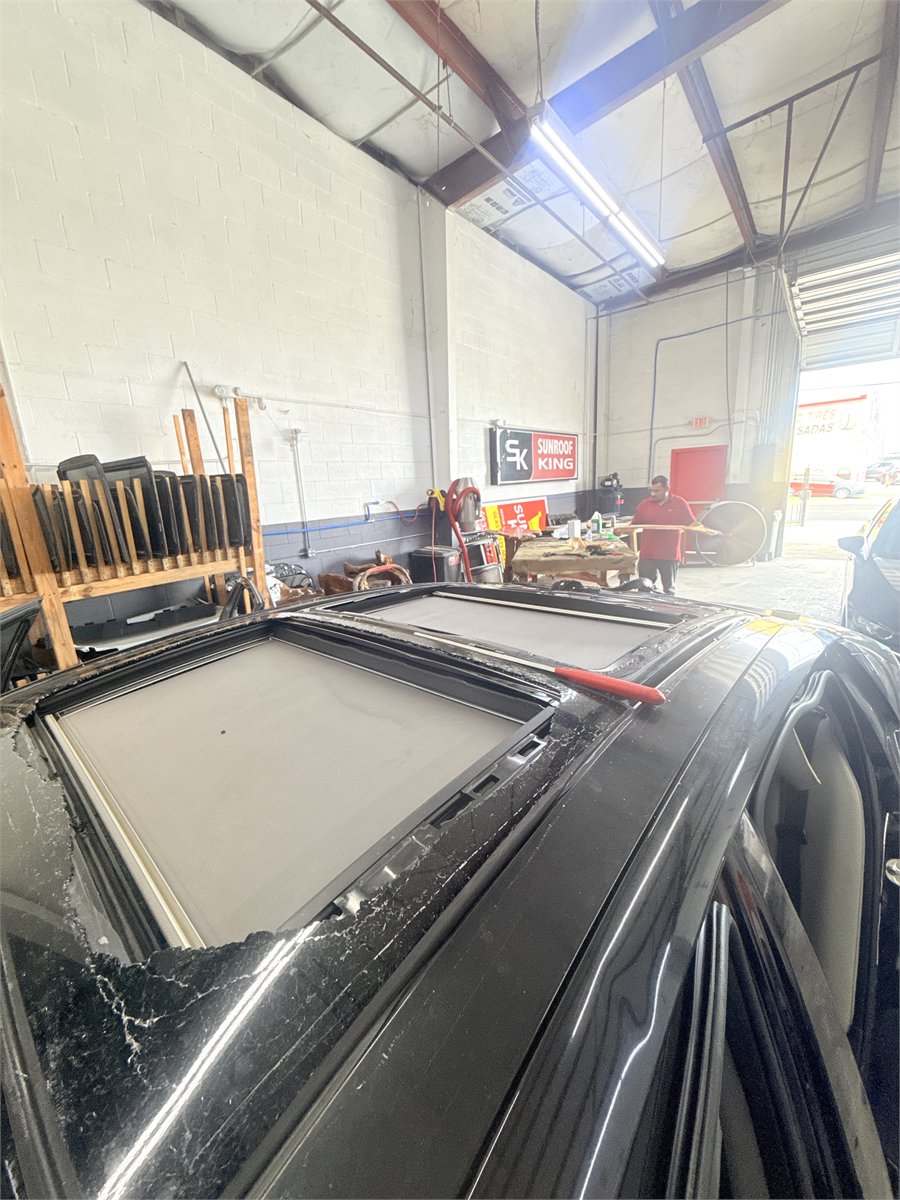
The roof opened up so the tracks, rails and mechanism can actually be seen — both at 9330 Westpark Dr.
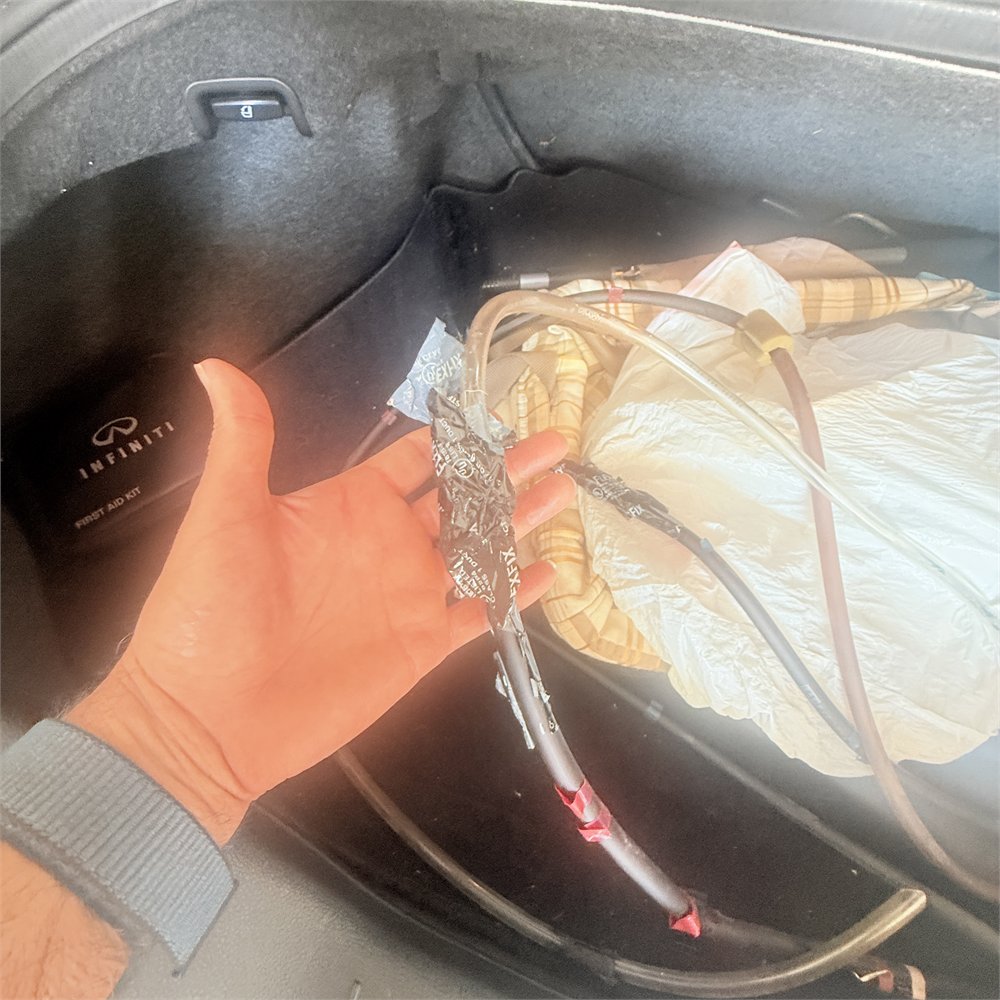
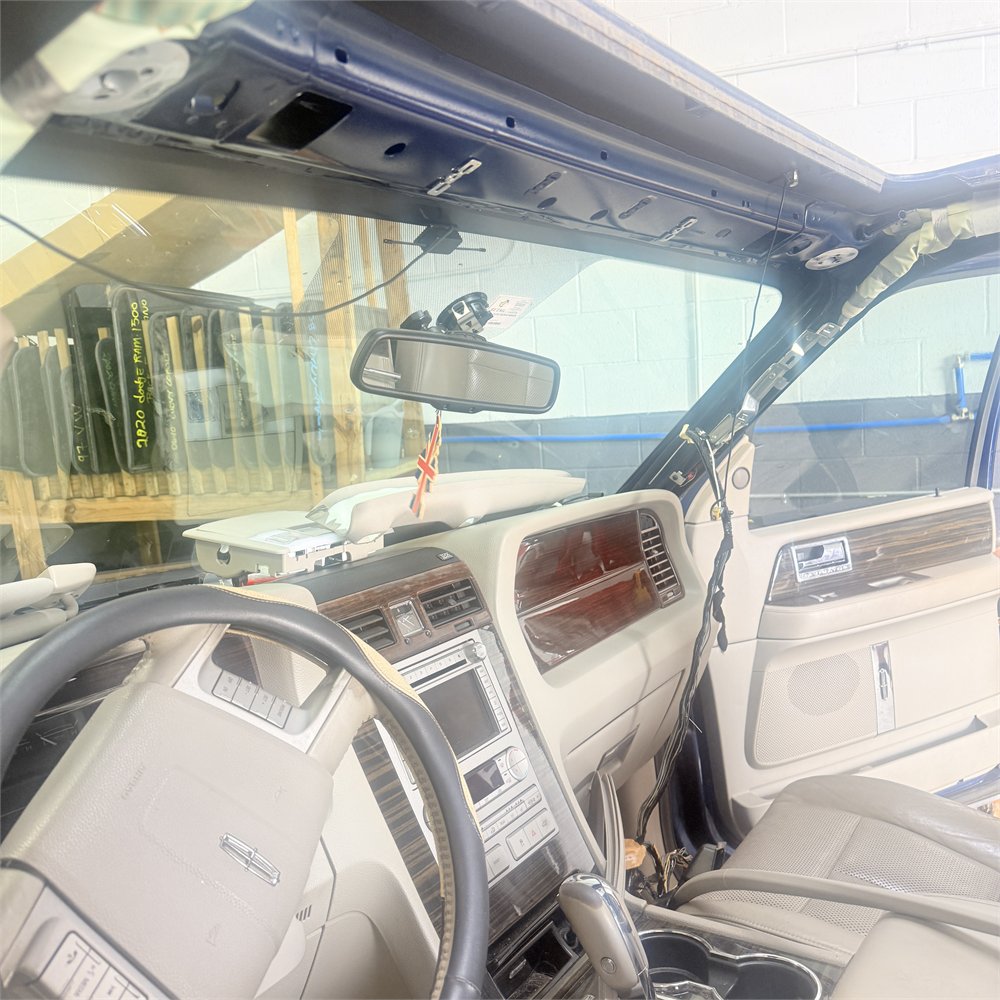
Cable and wiring inspection, and the roof structure exposed once the interior is opened up.
Roofs we work on. Stuck and jammed roofs come through the shop on a wide range of vehicles and roof types. If you are not sure whether yours is something we can help with, call or text and ask.
Interior And Headliner Access
Some sunroof faults can be reached from the roof opening. Many cannot, and it is worth knowing why before the vehicle comes in.
The roof cassette — the frame that holds the tracks, cables, lift mechanism, motor and drain tubes — sits in the space between the outer roof panel and the headliner. There is no way to reach most of it from outside the vehicle. So depending on what has failed and where, the repair may require lowering or removing trim, and sometimes the headliner itself, to get to the components that need work.
That is normal for this kind of repair rather than a sign that something has gone wrong. It does mean the job is a careful one: trim, pillar covers, visors, handles and consoles come out in order, the interior is covered before anything starts, and everything is refitted and checked afterwards.
Because we work on interiors as well as roofs, a headliner that is already sagging or stained can be dealt with at the same time if you want it to be — the labour of taking it down is happening either way. Our Auto Headliner Repair page covers that side of the work.
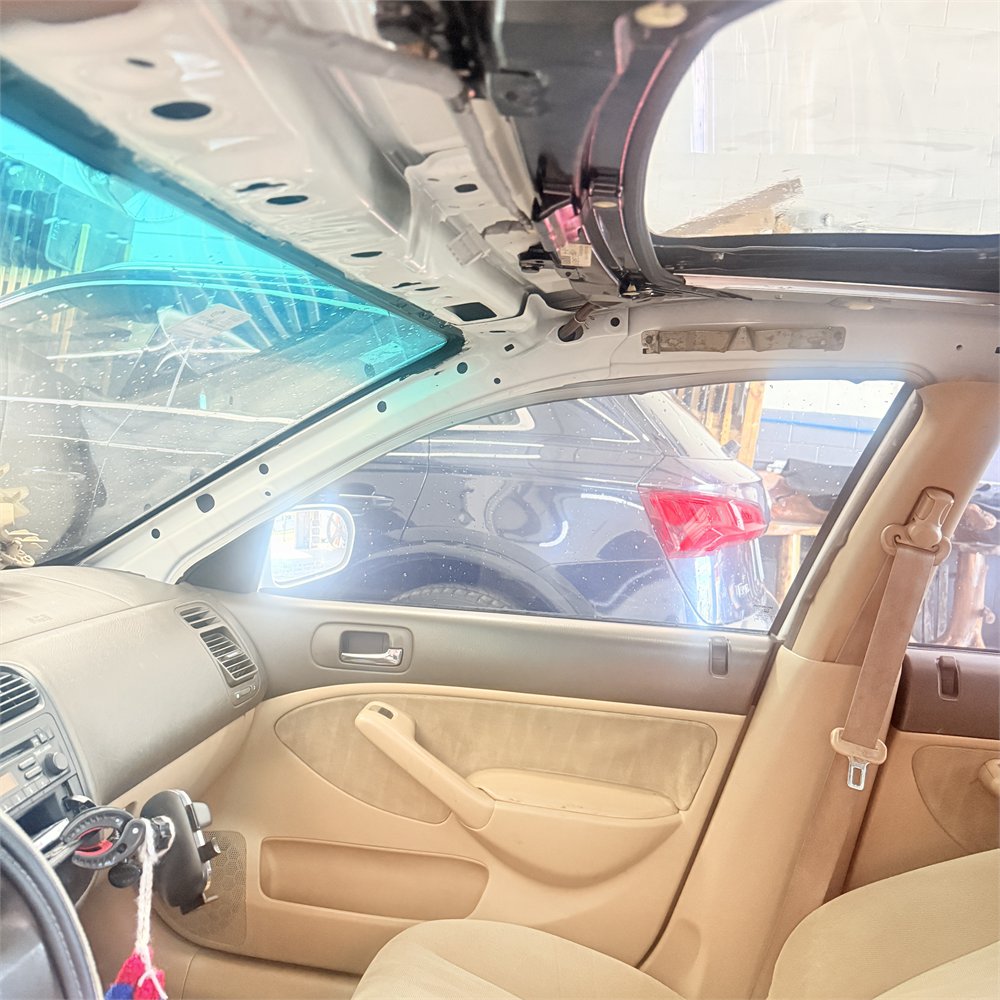
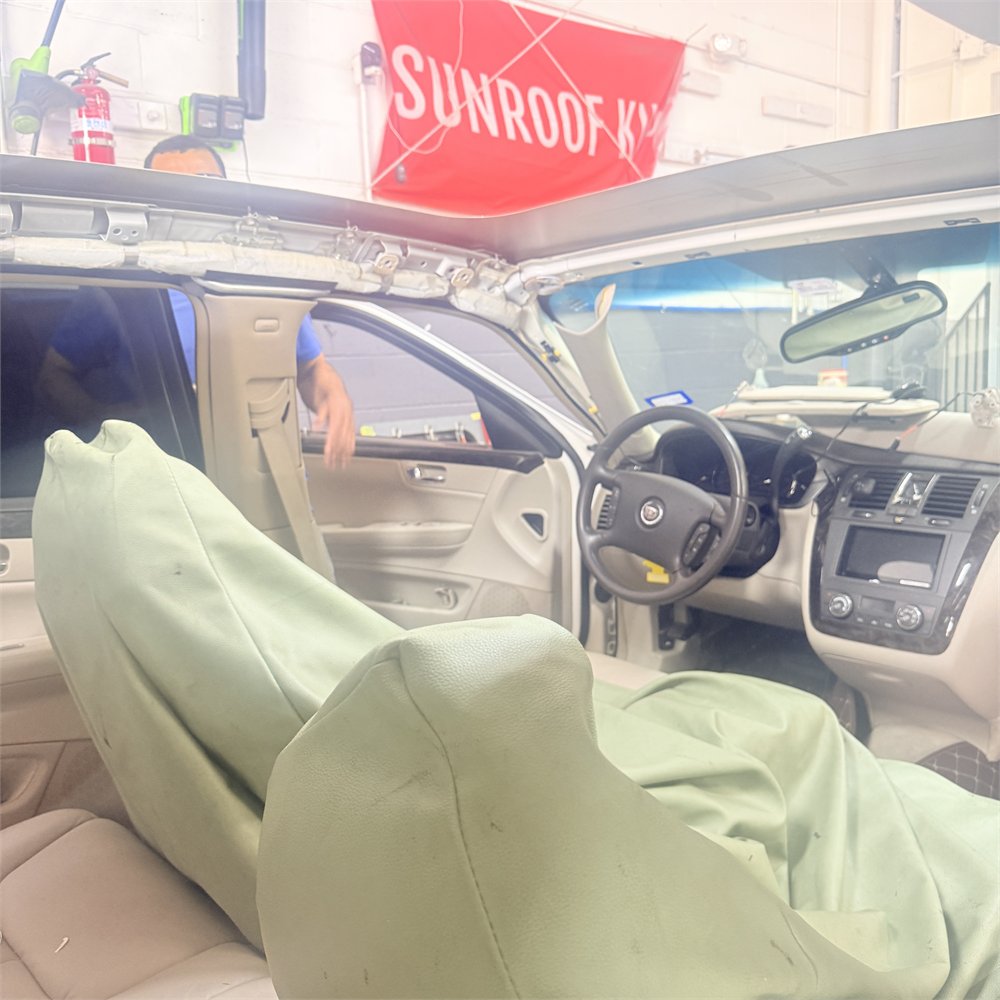
Headliner down to reach the roof assembly, and an interior covered before the work starts.
How We Approach Diagnosis
Not Every Vehicle Needs Every Step
The order below is how we generally work through a roof that is stuck, binding or moving incorrectly. It is a sequence, not a checklist that every vehicle runs through end to end — on some roofs the cause is obvious at step two and the rest is unnecessary.
Visual Inspection
We start by looking at the roof and the surrounding area — the condition of the glass, the seal, the visible edges of the opening and anything obviously damaged, displaced or out of place.
Check Roof Position And Alignment
Where the panel is currently sitting, and whether it is square in its opening. A panel that is high on one side, dropped at a corner or twisted is already pointing at where the problem is.
Observe Movement And Noise, Where It Is Safe To Do So
If the roof can be operated without risking further damage, watching and listening to what it does tells us a great deal — whether both sides move together, where it stops, whether it reverses, and what it sounds like while it happens. If operating it looks likely to make things worse, we do not.
Inspect The Accessible Tracks And Mechanism
The parts of the tracks, guides, sliders and drive components that can be reached without stripping the interior are checked for wear, damage, debris and anything binding.
Check Electrical And Motor Operation Where Appropriate
Where the symptoms or the inspection point that way, the electrical side is checked — power to the roof, the switch, connections and the motor. This step is done when it is relevant to the vehicle in front of us, not as a matter of routine.
Decide Whether Deeper Interior Or Headliner Access Is Needed
If the cause has not been established, or the parts involved sit inside the roof cassette, the next step is getting to them — which may mean lowering trim or the headliner. We tell you before that happens rather than after.
Explain What The Repair Actually Requires
Once we know what has failed, we explain what needs to be repaired or replaced and why, in plain terms. You decide whether to go ahead before any repair work starts.
Real Sunroof Repair Work In Our Shop
Filmed At 9330 Westpark Dr
A short clip of sunroof repair work being carried out at our Houston shop — our bay, our vehicles and our technicians. It is not a stock clip or a manufacturer video.
The video does not download until you press play, so it will not slow the page down on a phone or a slow connection.
If Your Roof Is Stuck, Please Read This First
Stop Operating It
If your sunroof is crooked, binding, grinding, repeatedly reversing or stuck part-way open, do not keep pressing the switch and do not try to force the panel by hand.
A roof behaving that way is already working against a mechanical problem. Every further attempt puts load through the components that are already the weak point, and that can turn a contained fault into a larger one — a strained cable into a broken cable, a worn guide into a damaged track. It is the single most useful thing you can do before the vehicle reaches us.
If The Roof Is Stuck Open
A roof stuck open leaves the interior exposed, and Houston weather does not give much notice. Until the vehicle can be inspected, park under cover where you can, or cover the opening so rain does not get into the cabin. Water sitting in the interior creates its own problems on top of the one you already have.
Call or text us on (832) 217-0430 and tell us the roof is open — it helps us to know.
What We Will Not Talk You Through Over The Phone
We are not going to give you instructions for manually forcing the mechanism, bypassing the motor, removing the glass, or dismantling tracks and cables. Those are not safe things to attempt on a roof that is already faulty, and in our experience they frequently add damage that was not there beforehand — including to the glass and to the interior.
Bring the vehicle in and let us look at it properly. All of our work is carried out at our Houston shop.