
Shade & Curtain Repair
Shades that sag, bunch, tear, jam open, refuse to close or run crooked in their tracks.
The shade — the curtain or sunscreen that slides under the glass to block the sun — is the part of a panoramic roof people notice failing first. It sits directly in your eyeline, so a shade that has dropped, bunched or stopped part way is impossible to ignore.
It is also its own system. Depending on the vehicle, a shade can involve its own tracks, guides, carriers, cables, drive components and material, which is why a shade fault and a glass fault are not the same problem and should not be diagnosed as though they were.
Sunroof King has been repairing sunroofs and panoramic roofs in Houston since 1979. Bring the vehicle to our shop and we will find out what has actually failed.

The Complaint We See Most Often
A shade that has dropped away from the roof and is hanging into the cabin is the failure people bring in most. It can appear as a shallow dip in the middle, a sagging pocket toward one end, material that has bunched into folds instead of lying flat, or a curtain that has come away from its edge altogether and is resting on the seats.
Sagging is a description of what you can see, not a diagnosis. On different vehicles it can involve the shade material itself, the carriers or sliders that hold its edges, the guides and tracks those run in, the tensioning or drive arrangement, or a combination of them. The design varies enormously between manufacturers, and so does the reason a shade stops sitting flat.
What is worth knowing is that a sagging shade rarely recovers on its own, and pushing it back up by hand does not address whatever let it drop. If the material has come out of its guides, working the shade repeatedly can draw more of it out of position.

A panoramic shade that has dropped away from the roof and is hanging into the cabin.
A shade stuck in the open position leaves the glass uncovered, which in a Houston summer is the version of this fault people want dealt with quickly. The cabin heats up, and on a large panoramic roof there is a great deal of glass with nothing under it.
Whether the shade is powered or hand-operated, what stops it closing depends on the vehicle. It can involve the tracks and guides the shade runs in, the carriers or sliders at its edges, the cables or drive components that move it, the material itself if it has bunched or come out of position, or on a powered system the motor and control side.
Those are possibilities, not a diagnosis. Two vehicles with an identical complaint can have entirely unrelated causes, which is why the roof needs to be looked at rather than assessed from the symptom.
The same system can fail in the opposite position, leaving a shade that will not retract. The roof stays permanently shaded, the light the panoramic glass was fitted for never arrives, and on many vehicles the glass itself may still open above a shade that will not move.
It is tempting to treat this as the lesser problem and leave it, precisely because nothing is hanging down and nothing is letting the sun in. But a shade that will not retract is stuck for a reason, and that reason is usually mechanical.
Diagnosis should come before parts. A shade assembly is not a cheap thing to replace speculatively, and on many vehicles the failure is in one component rather than the whole assembly. Establishing which is the difference between a targeted repair and an expensive guess.
A shade that travels part of the way and then stops — every time, in roughly the same place — is giving you more information than one that will not move at all. Something is interfering with its travel at that point.
Incomplete travel can come from binding in the tracks, a damaged guide or carrier, debris or a displaced component in the path, material that has bunched and is jamming against itself, or a cable, drive or mechanism fault. On powered systems it can also be the control side rather than a physical obstruction.
As with every other symptom on this page, where it stops narrows the search — it does not complete it. The useful thing you can do is note whether it always stops in the same place and whether anything can be heard while it happens, then let it be inspected rather than running it repeatedly to see whether it will get through.
If one side of the shade travels while the other lags, or the leading edge sits at an angle instead of square across the roof, the shade is running crooked. The same appearance shows up when one edge has come out of its guide and the material is no longer supported on that side.
On most designs both sides are meant to move together. When they stop doing so, the components involved can include the tracks, the guides, the carriers or sliders at the shade's edges, the cables or drive arrangement, and the alignment of the assembly itself. Material that has already stretched or torn on one side can produce the same result.
A crooked shade is a shade under strain. Once it is running out of square, continuing to operate it works the material and the carriers against the guides rather than along them — which is how an edge that had merely slipped ends up damaged.

A shade edge that has come away from where it should sit — photographed at our Houston shop.
Sometimes the material itself is the problem: a tear along an edge, a split where it has been folding in the same place, fraying where it enters its guides, or fabric that has stretched enough that it no longer sits under tension.
Physical damage does not reverse. Unlike a shade that has merely slipped out of position, torn material will not go back to working correctly once it is repositioned.
We will not promise that every shade can be put right without replacing the material. Whether damaged material can be dealt with, or whether some or all of the shade assembly needs replacing, depends on the design of the system and how far the damage has gone. Some vehicles allow the material to be addressed on its own; on others the material is part of an assembly that is supplied and replaced together. That is a question about your specific vehicle, and it is one we answer after looking at it — not before.
Worth Understanding Before You Book Anything
This is the single most useful thing to understand about panoramic roofs, and it is the point most often missed.
On many panoramic systems the glass panel and the sunshade are separate mechanisms. They share the same roof and often the same cassette, but they have their own components and move independently of each other. That has some practical consequences:
The glass can work perfectly while the shade is broken. Your roof may open, close and tilt exactly as it always did while the shade sags, jams or refuses to move. Nothing is wrong with the glass mechanism — the fault is in a different system that happens to live in the same space.
The shade can misbehave while the glass appears fine. A shade running crooked or stopping halfway does not mean the roof mechanism is failing, and it is not a warning sign about the glass.
So the two need to be told apart before anything is quoted. A complaint of "my panoramic roof is broken" can mean either system, and they are not interchangeable repairs. It is entirely possible to have work done on a roof mechanism that was never at fault while the shade that actually failed goes untouched.
If it turns out the glass side is involved after all, that is covered on our Panoramic Sunroof Repair and Sunroof Stuck Open or Closed pages. Establishing which system is at fault is part of what the inspection is for.
What A Shade System Can Involve
Shade designs differ a great deal between manufacturers, and between a hand-operated shade and a powered one. Depending on the vehicle, the parts involved in moving a shade can include:
Tracks and guides — the channels the shade's edges run along.
Carriers and sliders — the pieces that hold those edges and travel in the guides.
Cables and drive components — what actually pulls the shade along on many systems.
A motor and its controls — on powered shades only.
The shade material — the fabric or panel itself, and however it is tensioned.
Cassette-related components — the frame the whole assembly is mounted in.
Not every vehicle uses every one of those. Plenty of shades have no motor at all. Some run on carriers in guides with no cable involved. Listing the possibilities is not the same as saying your vehicle has all of them — it is there to show why "the shade is broken" is a starting point rather than an answer.
Because these parts work as a chain, a failure in one commonly shows up as a symptom somewhere else. A worn guide lets a carrier sit wrong; a carrier sitting wrong drags the material; dragged material bunches; bunched material jams the travel. The thing you notice is at the end of that sequence, not the start of it, which is exactly why we look at the assembly rather than replacing the part the symptom points at.
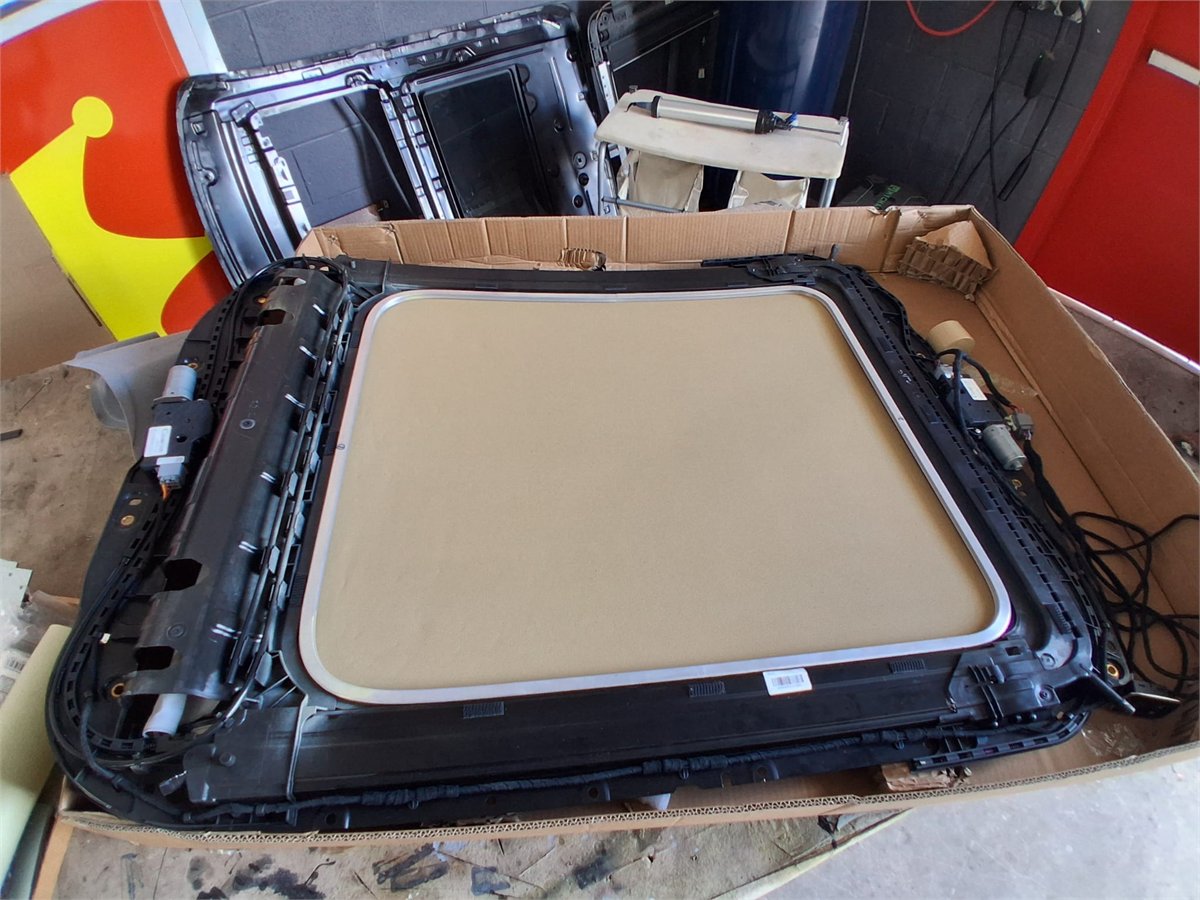
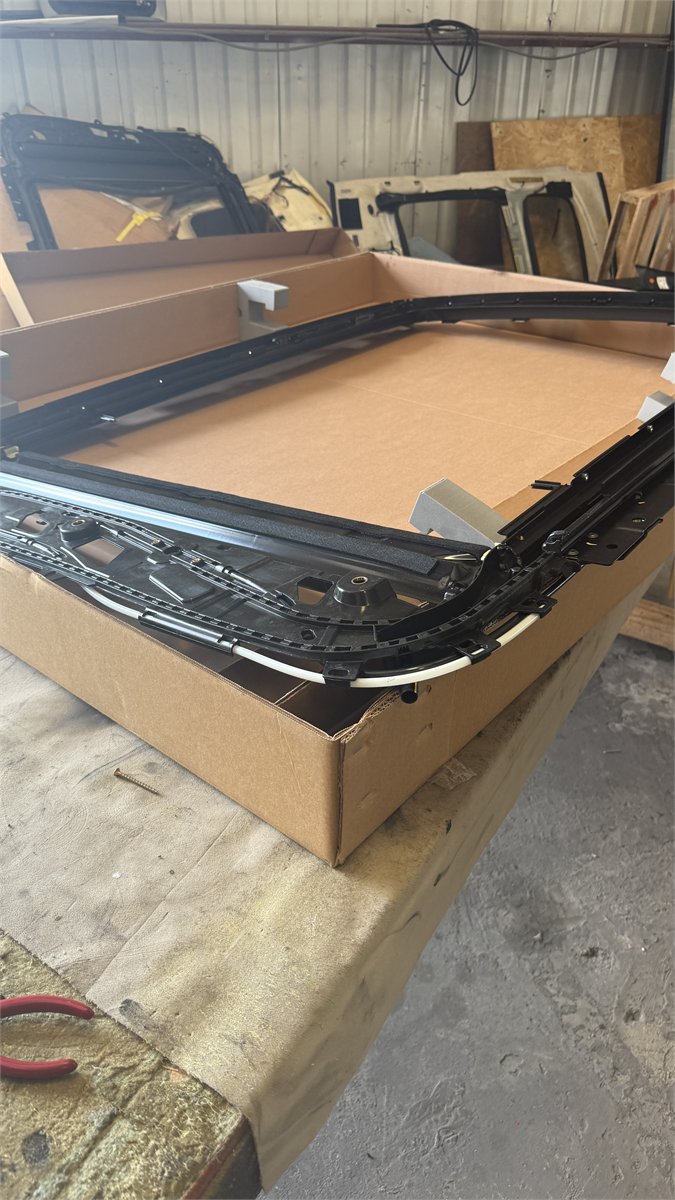
The assembly out of the vehicle with the shade in its frame, and a cassette on our workbench — both at 9330 Westpark Dr.
Roofs we work on. Shade and curtain faults come through the shop on a wide range of vehicles and roof designs. If you are not sure whether yours is something we can help with, call or text and ask.
And Why This Is Shop Work
A shade lives in the space between the glass above it and the headliner below it. There is no panel you can unclip from inside the cabin to reach it, and there is no way to it from outside the vehicle.
So depending on what has failed and where it sits, a shade repair can require some or all of the following: removing interior trim around the roof, lowering or removing the headliner, accessing the roof cassette from inside the vehicle, and in some cases removing or repositioning other roof components to reach the shade assembly.
Not every shade job requires full cassette removal. Some faults are reachable with far less disassembly than that, and part of the inspection is establishing how far in we actually need to go. What we will not do is guess at that in advance and quote you for work that may not be necessary.
What this does explain is why shade repair is proper shop work. A vehicle with its headliner down is a vehicle with its interior partly dismantled — it needs to be under cover, with the trim, fixings and components kept in order and the interior protected. That is not something to attempt in a parking lot or a driveway, and it is why all of our work is carried out at our Houston shop. If your headliner is already sagging or marked, it is also the sensible moment to deal with it, since the labour of taking it down is happening anyway — see our Auto Headliner Repair page.

Headliner out and the roof structure exposed — the access a major shade repair can require.

A vehicle opened up in our bay at 9330 Westpark Dr while its shade is worked on.
Not Every Vehicle Requires Every Step
The sequence below is how we generally work through a shade fault. It is an order of work, not a checklist every vehicle runs end to end — on some roofs the cause is clear at step two and most of what follows is unnecessary.
Where the shade is currently sitting, whether it is square across the roof, and the state of the material and its visible edges — sagging, bunching, fraying, tearing or an edge out of its guide.
If the shade can be moved without risking further damage, watching how it travels tells us a great deal — whether both sides keep pace, where it stops, and whether anything can be heard. If operating it looks likely to make matters worse, we leave it where it is.
Establishing whether the problem is the material, a track, a guide, a carrier, a cable, a drive component, a motor on a powered system, or something else. This is the step that decides everything after it.
How far the interior needs to come apart to reach the fault — trim only, headliner lowered, or fuller access to the cassette. We tell you what is involved before that work starts rather than afterwards.
Trim and components are removed in order, with the interior covered first, so the shade assembly can be reached without damaging anything on the way to it.
What has actually failed is dealt with. Depending on the vehicle and the fault, that can mean a component within the shade system or, where the design requires it, a larger part of the assembly.
The shade is set back up to run square in its guides, and the trim, headliner and components that came out are refitted and checked for correct fit.
The shade is run through its full range of movement, in both directions, to confirm it travels squarely and completes its travel before the vehicle is handed back.
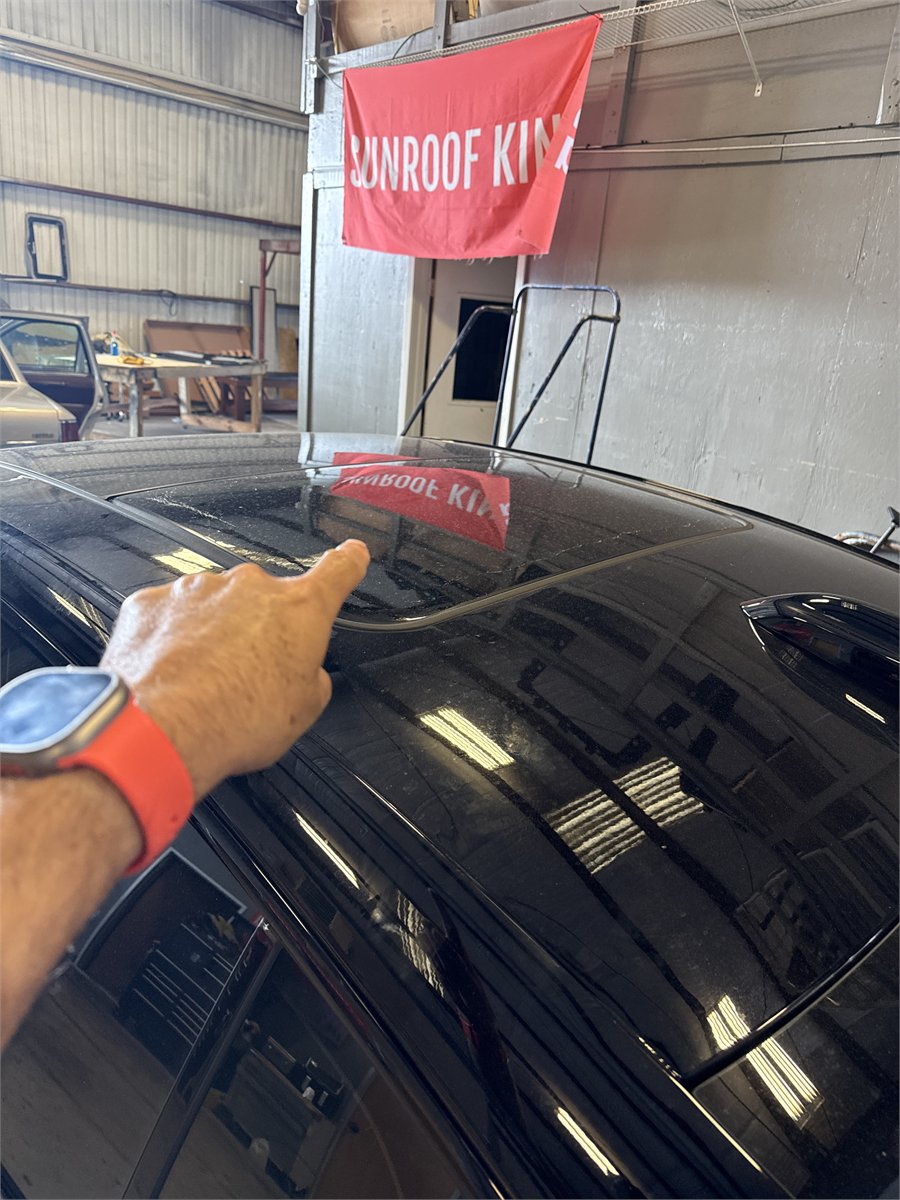
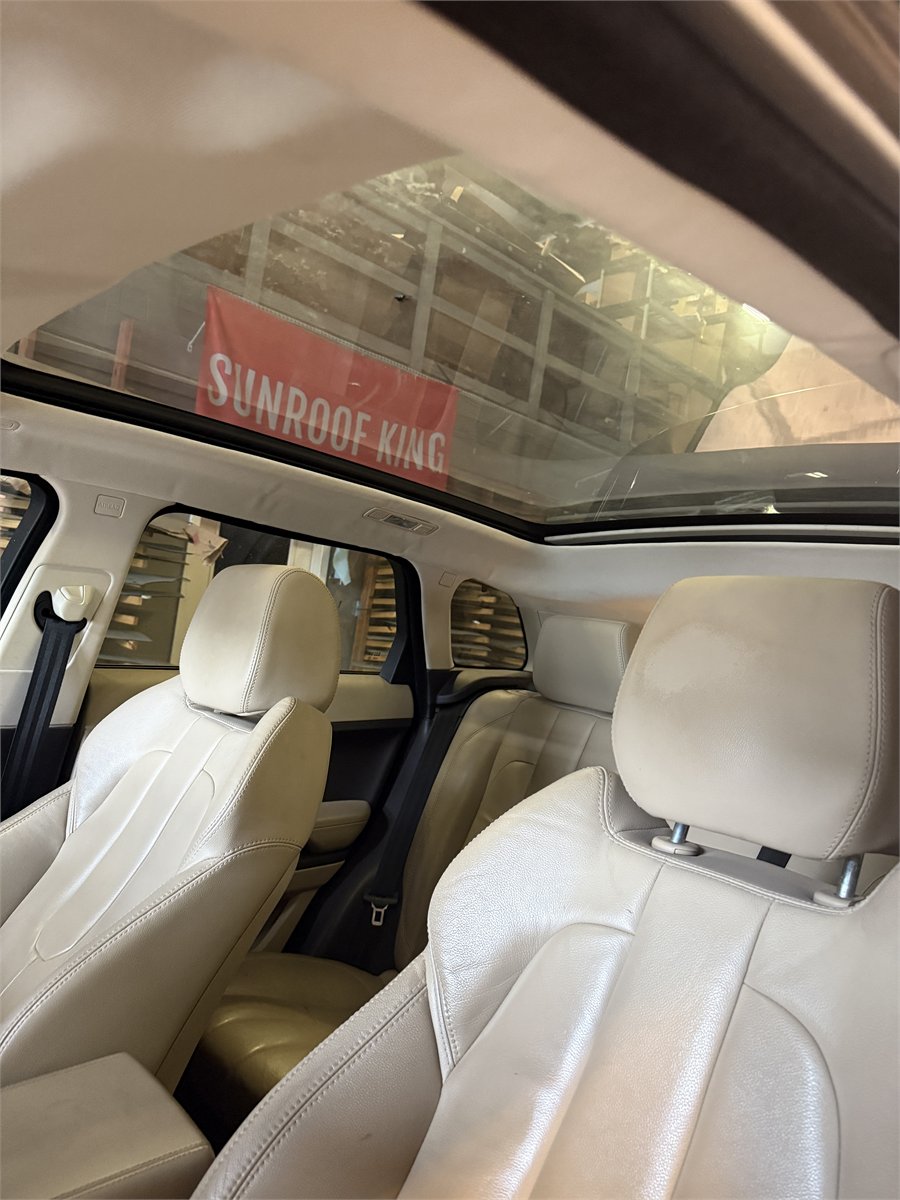
Assessing a roof at the vehicle, and a panoramic shade back in service afterwards.
Filmed At 9330 Westpark Dr
A clip of shade repair work being carried out at our Houston shop — our bay, our bench and our technicians. It is not a stock clip or a manufacturer video.
The video does not download until you press play, so it will not slow the page down on a phone or a slow connection.
If your shade is crooked, bunched up, binding, making unusual noises or repeatedly stopping in the same place, do not keep operating it and do not force it by hand.
A shade behaving that way is already working against a mechanical problem. Continuing to run it puts load through whatever is already the weak point, and that can add damage that was not there before — material drawn further out of its guides, a slipped edge torn, a strained carrier broken. Leaving it where it is until it can be inspected is genuinely the most useful thing you can do.
We are not going to give you instructions for forcing the curtain, pulling cables by hand, dismantling tracks, removing the headliner, bypassing a motor, or taking out roof and cassette components.
Those are not safe things to attempt on an assembly that is already faulty, and they sit behind trim and a headliner that have to come out in a particular order. In our experience these attempts frequently add damage — to the shade material, to the trim, and to the interior — that was not part of the original problem.
Call or text (832) 217-0430 and describe what the shade is doing — whether it sags, jams, runs crooked or stops in the same place each time. All of our work is carried out at our Houston shop, Monday to Friday, 8:00 AM to 5:00 PM.